
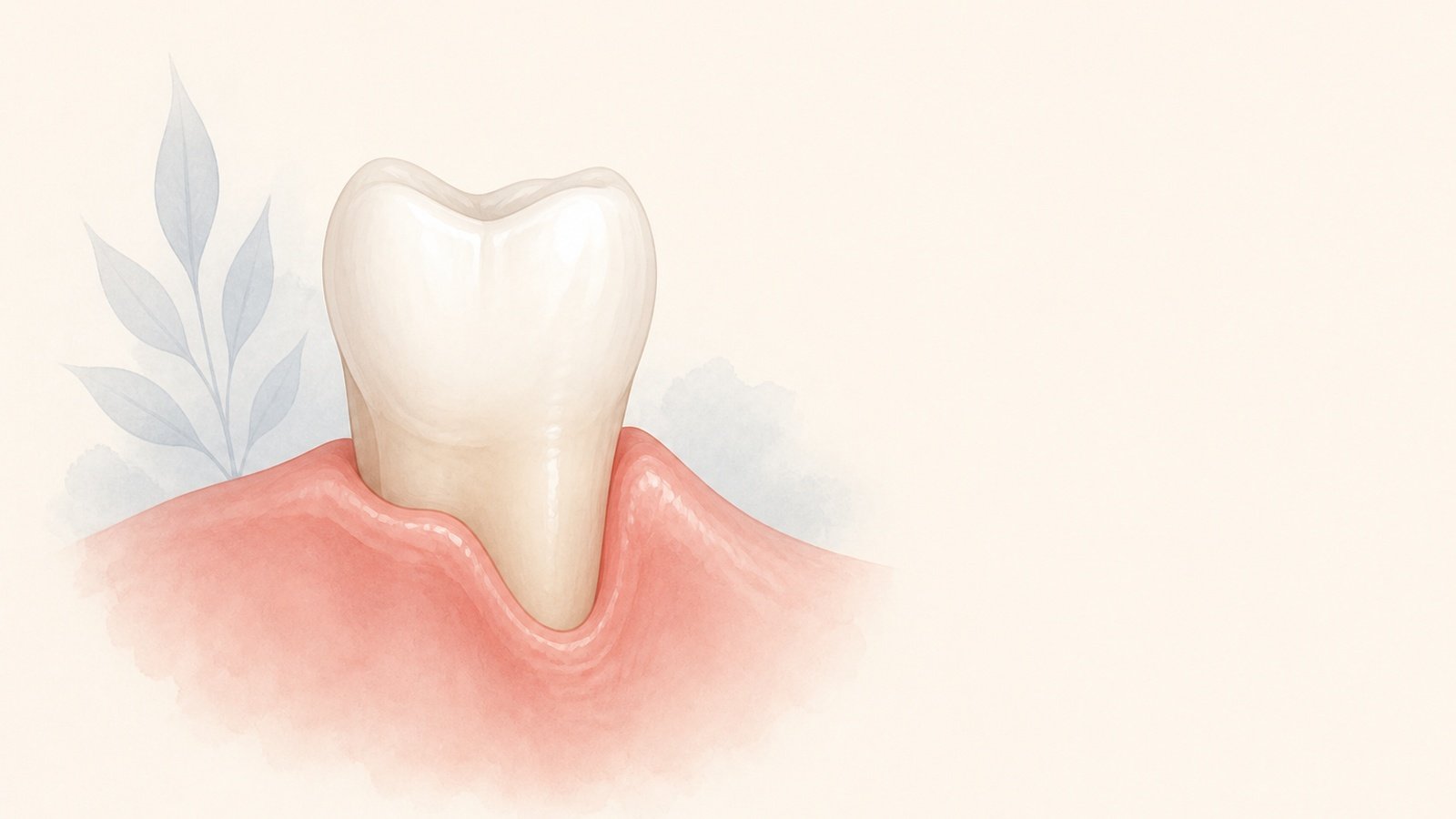
If your teeth look longer than they used to, your gumline looks uneven, or a tooth has become more sensitive, you may be noticing receding gums. Receding gums—also called gum recession or gingival recession—means gum tissue has pulled away from or been lost around a tooth, exposing more of the tooth root.
That description does not identify the cause. A visible change, photograph, or single symptom cannot establish how severe the recession is or whether gum disease is involved. Several factors can contribute, so a professional evaluation is the safest way to understand what is happening.
What do receding gums mean?
Gum recession can create a visible notch near the gumline, make a tooth appear longer, or expose part of the root. The root surface does not have the same enamel protection as the visible crown of the tooth. As a result, exposure may affect comfort and may leave the area more vulnerable to root-surface decay.
Not every changing gumline has the same explanation. The appearance may be relevant, but an evaluation is needed to assess the gums, supporting tissues, tooth position, and other factors that cannot be confirmed in a mirror.
What causes receding gums?
There is no single cause that applies to every person. The causes of receding gums may include periodontal inflammation, mechanical irritation, anatomical or positional factors, and other health or lifestyle factors. Common categories include:
Periodontal inflammation and gum disease
Plaque and tartar can contribute to inflammation and periodontal disease. When periodontal disease affects the tissues and bone supporting the teeth, gumline changes may be part of a broader oral-health concern. That does not mean every case of receding gums is caused by gum disease; an examination is needed to distinguish the visible recession from the condition contributing to it.
Brushing pressure and other mechanical irritation
Aggressive scrubbing, excessive pressure, or an unsuitable brushing technique may irritate vulnerable gum tissue. A dental professional can help assess whether cleaning habits may be contributing and suggest a gentler approach without assuming that brushing is the only explanation.
Tissue anatomy, tooth position, or orthodontic history
Some people have thinner gum tissue or other anatomical features that may make recession more likely in a particular area. Tooth position, alignment, or a history of orthodontic movement may also matter. These factors are not something a reader can reliably confirm from appearance alone.
Tobacco, grinding, trauma, and other factors
Tobacco use, clenching or grinding, trauma, oral piercings, dry mouth, certain medications or health conditions, and hormonal changes may be relevant in some cases. These are possibilities rather than a checklist for self-diagnosis, and more than one factor may be present.
Why can receding gums cause sensitive teeth?
When a root becomes exposed, the tooth may react more strongly to cold, heat, sweet or acidic foods, touch, or brushing. Exposed root surfaces transmit stimuli differently from enamel-covered tooth structure, which can help explain sensitivity.
Sensitivity has other possible causes, so it does not prove that gum recession is present. Exposed roots may also be more vulnerable to root-surface decay. If periodontal disease is present, a clinician may need to assess inflammation, periodontal pockets, supporting bone, and tooth stability as well.
When should you see a dentist for receding gums?
Consider arranging a dental evaluation if you notice a new or persistent change, visible root exposure, increasing sensitivity, bleeding or swollen gums, persistent bad breath, pain when chewing, or a tooth that feels loose or appears to be separating. These signs do not identify the cause, but they are useful reasons to have the area assessed rather than assuming the change will resolve on its own.
A periodontal evaluation may include an examination of the gumline, inflammation and bleeding, periodontal pocket measurements with a probe, tooth stability, and your medical and dental history. X-rays may be recommended when clinically indicated to assess supporting bone or other conditions. These measurements help a clinician understand what cannot be determined from appearance alone.
What might treatment for receding gums involve?
Treatment depends on the underlying cause, the extent of the recession, your overall oral health, the anatomy of the area, and other individual clinical findings. There is no universal treatment path, and not every case requires deep cleaning or gum surgery.
Depending on the evaluation, management may include guidance on oral-hygiene technique, professional plaque or tartar control, scaling and root planing when periodontal disease is present, care to reduce sensitivity, monitoring an area that is stable, or a selected root-coverage or grafting procedure. These options are not interchangeable, and a reader should not choose one based on a symptom or online description.
The goal may be to control contributing factors, protect exposed root surfaces, reduce sensitivity, stabilize the area, or discuss root coverage when a clinician believes it is appropriate. Treatment planning should follow examination findings rather than an assumed diagnosis.
What can you safely do while arranging care?
Use a soft-bristled toothbrush and a gentle brushing technique rather than scrubbing the gumline. Clean between your teeth as advised by your dental professional, avoid tobacco, and be cautious about harsh or aggressive products. These habits support oral health, but they do not diagnose the cause or regrow lost gum tissue.
It can also help to note when you first noticed the change, what triggers sensitivity, and any recent dental, orthodontic, medication, tobacco, grinding, or injury history. Sharing those details can make the evaluation more useful.
Can receding gums grow back naturally?
Lost gum tissue does not naturally grow back. That does not mean every person needs a procedure. Depending on the findings, realistic goals may include controlling contributing factors, protecting exposed root surfaces, reducing sensitivity, stabilizing a stable area, or discussing a selected root-coverage approach.
Do receding gums always mean gum disease?
No. Periodontal disease is one possible contributor, but mechanical, anatomical, positional, tobacco-related, and traumatic factors may also be involved. Only an examination can clarify the cause and whether supporting tissues are affected.
Does every case need deep cleaning or gum surgery?
No. The appropriate approach depends on the cause, severity, oral health, tissue anatomy, and clinical findings. Some situations may be managed with improved technique, professional care, sensitivity management, or monitoring; other situations may call for additional treatment.
What should you ask at your visit?
You may want to ask: What could be contributing to this change? Is there inflammation or supporting-tissue loss? How do the pocket measurements look? What is the goal of treatment? What can protect the exposed root? These questions can help you understand the evaluation without trying to diagnose yourself beforehand.
The next step for a changing gumline
A changing gumline is a reason to seek clarity, not a reason to assume the worst. Receding gums can have multiple contributors, and exposed roots or sensitivity may deserve attention even when the cause is not obvious.
You can review Wengrover Dental Arts’ periodontal and gum-health care information for context. If you are concerned about a new or persistent change, contact Wengrover Dental Arts to arrange an evaluation. The purpose of that conversation is to understand your individual findings and options—not to assume a diagnosis or promise a particular procedure.